Attics, walls, and crawl spaces across Cookeville and the Upper Cumberland — air-sealed and insulated in one pass.
Call (555) 555-5555Or call — we answer. No obligation, honest advice.
The Upper Cumberland asks a lot of a house. Humid Tennessee summers push damp air at every crack from below; real winters — especially up the plateau toward Monterey — pull heat out through every gap above; and in between sit thousands of homes on vented crawl spaces that were standard practice when they were built and are moisture machines now. Cookeville's growth has added a newer generation of houses on top, tighter but rarely as tight as their owners assume.
Cookeville Spray Foam Co works that whole housing stock. Spray foam insulation that air-seals while it insulates — which is the entire point of foam over batts — attic work that stops the biggest leak in any house, and crawl space encapsulation that ends the summer-long argument between your floor system and the humidity underneath it.
Free assessments and written quotes across Putnam County and the Upper Cumberland. Call (555) 555-5555 and describe the house — the cold room, the bill, the musty smell — and get an honest read on what's actually causing it.
Vented crawl spaces made sense on paper: let air flow through and moisture out. Middle Tennessee's humidity runs the experiment in reverse — all summer, the vents inhale damp outside air that condenses on cool ductwork and framing. The results live upstairs: musty smells, cupping floors, sweating ducts, and a dehumidifier that never wins.
Encapsulation flips the design: seal the vents, foam the walls, ground barrier down, and the crawl space joins the conditioned side of the house. It's the single highest-impact fix for this region's most common house problem.
Three services cover the Upper Cumberland's housing stock from the dirt to the ridge. Each links to its own page.
Open-cell and closed-cell foam for walls, rooflines, rim joists, and metal buildings — with honest guidance on which foam belongs where.
Air-sealing and insulation for the plane where most homes lose the most energy — attic floor or roofline, matched to how the house is built.
Sealed, foamed, and moisture-controlled crawl spaces that stop feeding humidity into the house above them.
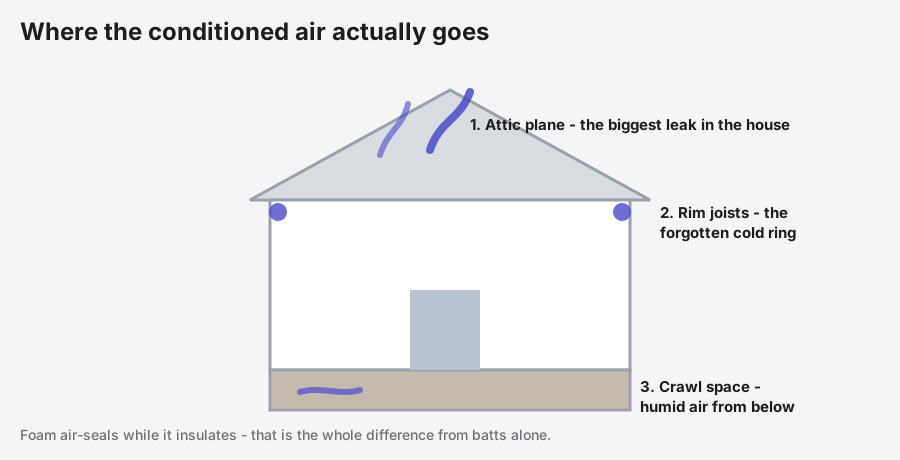
Every house leaks in the same three places. The attic plane is the big one — warm air rises, finds every penetration around lights and plumbing and chimneys, and exits, pulling replacement air in below. The rim joist — that ring of framing where the house sits on its foundation — is the leak nobody sees and almost nobody's insulated. And the crawl space or basement feeds the whole cycle from underneath.
This is why foam earns its price where batts can't: fiberglass slows heat moving through materials but does nothing about air moving past them, and in a leaky house, moving air is most of the bill. Foam does both jobs in one application — it insulates and it air-seals — which is the entire economic argument in two words.
The honest corollary: not every house needs foam everywhere. An assessment that finds your actual leak points beats a quote that just prices your square footage.
Two foams, two jobs, and a lot of confusion sold in between. Open-cell foam is lighter, more affordable per inch, an excellent air-sealer, and vapor-permeable — the usual right answer for rooflines and interior walls, where you want air-sealing and sound control without trapping moisture inside assemblies. Closed-cell is denser, insulates more per inch, adds rigidity, and above a couple of inches acts as its own vapor barrier — the right tool for rim joists, crawl space walls, under-slab-adjacent work, and metal buildings.
A contractor who quotes one foam for everything is selling inventory, not solutions. The honest version matches foam to assembly: open-cell where the house needs to breathe, closed-cell where moisture is the enemy, and sometimes neither — because if the diagnosis says your problem is a disconnected duct or an uninsulated attic hatch, foam isn't the fix and shouldn't be the invoice.
One incentive note worth knowing before anyone promises you savings: the federal energy-efficiency tax credit that covered insulation ended for projects after December 31, 2025. Copy that still promises you a federal credit is out of date. Utility programs in the Tennessee Valley change over time, so the current answer on rebates comes from your utility — ask, and bring their answer to the estimate; the math gets run with real numbers, not wishful ones.
And the standing advice for hiring anyone in this trade, us included: Tennessee licenses contractors above a project-cost threshold, insurance certificates can be sent directly from any legitimate insurer, and foam manufacturers certify installers in their systems. Ask which foam system is being quoted and for the manufacturer's spec sheet. An installer who welcomes those questions is the one you want in your crawl space.
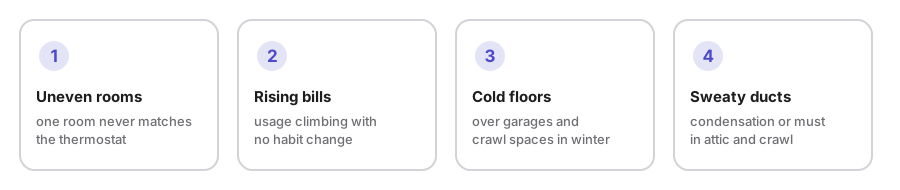
Uneven rooms, rising bills, cold floors, and condensation where it shouldn't be — the house reports its leaks; the assessment just translates.
The same sequence for a bungalow near Tech and a farmhouse out toward Gainesboro.
The assessment finds where your house actually leaks — attic plane, rim joist, crawl — so the quote fixes causes instead of pricing square feet.
Open or closed cell specified per assembly with the reasoning written down, so you know what's going into your walls and why.
Proper prep, masking, and cure ventilation on every job — foam installed right is inert; installed carelessly is a callback.
Cookeville anchors the whole Upper Cumberland, and Tennessee Tech gives it a rental market that runs on utility math. For landlords, insulation is one of the few upgrades that pays twice — lower vacancy from tenants whose bills aren't punishing, and a floor system that stops growing the musty smell that kills a showing.
Rental work runs on documentation: written scope approved by the owner before work starts, photos after, and scheduling coordinated with tenants. For owner-occupants, the same paperwork just means you know exactly what you bought.
The service area runs with the hub: Algood and Baxter next door, up the plateau to Monterey where winter means it, Sparta and Livingston and the county roads between. Elevation changes the math here — plateau homes carry a heavier heating season than the basin, and the assessment accounts for which climate your house actually lives in.
Based in Cookeville and covering the Upper Cumberland — Putnam County wall to wall, and the neighboring county seats and communities that treat Cookeville as their hub city.
Out past the usual lines? Call anyway. Rural metal buildings and farmhouses are half this region's work.
Hub of the Upper Cumberland, home of Tennessee Tech, where the basin meets the plateau.
The Upper Cumberland builds in steel — shops, barns, ag buildings, and the barndominium wave that turns them into homes. Metal buildings without foam sweat like a cold drink in July: interior air hits steel skin at outdoor temperature and condensation rains on everything stored or living inside.
Closed-cell foam is the purpose-built answer — it bonds to the metal, kills the condensation surface, stiffens the panels, and turns an uninsulatable shell into a conditioned space in one application. Shops become year-round workspaces; barndominiums become actual houses.
Ag and shop work gets scheduled around what the building does — harvest calendars, livestock, the equipment that can't move far. Say what the building holds and the plan works around it.
A crawl space you can smell from the hallway, an attic that turns July into a furnace, a bonus room no thermostat can reach, a metal shop that rains indoors, or just a utility bill that keeps writing its own sequel — call (555) 555-5555 and describe it. Free assessment, written quote, honest foam.
Houses in this region don't have insulation problems so much as air problems. Fixing the air is the whole trick.
Tell us what you need and we'll get back to you with a real answer. If it's an active backup or standing water over the field, calling gets you a faster response.
Call: (555) 555-5555
Area: Cookeville, TN and Putnam County